
Monday, May 01, 2006


Sunday, April 30, 2006
Friday, April 28, 2006
such a sad, sad situation
There was an old man whose despair
Induced him to purchase a hare:
Whereon one fine day,
He rode wholly away,
Which partly assuaged his despair.
(Edward Lear)
Induced him to purchase a hare:
Whereon one fine day,
He rode wholly away,
Which partly assuaged his despair.
(Edward Lear)
Wednesday, April 26, 2006
... several experiences in consciousness that I have had ...
"You may be indisposed to Waldo Frank, but I must recommend to you City Block as the richest in content of any 'fiction' that has appeared in the American 20th century. Frank has the real mystic's vision. His apprehensions astonish one. I have also enjoyed reading Ouspensky's Tertium Organum lately. Its corroboration of several experiences in consciousness that I have had gave it particular interest."
Hart Crane (in Ohio) writing to Allen Tate (in Kentucky), 15 Feb 1923
Hart Crane (in Ohio) writing to Allen Tate (in Kentucky), 15 Feb 1923
turning Japanese - snippets
Medbh McGuckian: "I also love Paul Muldoon's Japanese side, and recall a happy occasion in New York in a sushi restaurant where we felt really exalted!"
Ciaran Carson: "The desktop image of the PC I am writing this on is a reproduction of Hokusai's great print, 'Sudden Gust of Wind': under Mount Fuji, travellers' papers are scattered up into the air, they are holding on to their hats. I love its clarity, its movement, and its sense of humour."
(Journal of Irish Studies, XVII, 2002)
Ciaran Carson: "The desktop image of the PC I am writing this on is a reproduction of Hokusai's great print, 'Sudden Gust of Wind': under Mount Fuji, travellers' papers are scattered up into the air, they are holding on to their hats. I love its clarity, its movement, and its sense of humour."
(Journal of Irish Studies, XVII, 2002)
Monday, April 24, 2006
Sunday, April 23, 2006
Jambalaya
Goodbye Joe, me gotta go, me oh my oh
Me gotta go pole the pirogue down the bayou
My Yvonne, the sweetest one, me oh my oh
Son of a gun, we’ll have good fun on the bayou
Jambalaya, a crawfish pie and a file gumbo
’cause tonight I’m gonna see my machez a mio
Pick guitar, fill fruit jar and be gay-oh
Son of a gun, we’ll have big fun on the bayou.
Thibodeaux, fontainbleau, the place is buzzin’
Kinfolk come to see Yvonne by the dozen
Dress in style, go hog wild, me oh my oh
Son of a gun, we’ll have big fun on the bayou.
[corrections / quibbles positively welcomed]
Me gotta go pole the pirogue down the bayou
My Yvonne, the sweetest one, me oh my oh
Son of a gun, we’ll have good fun on the bayou
Jambalaya, a crawfish pie and a file gumbo
’cause tonight I’m gonna see my machez a mio
Pick guitar, fill fruit jar and be gay-oh
Son of a gun, we’ll have big fun on the bayou.
Thibodeaux, fontainbleau, the place is buzzin’
Kinfolk come to see Yvonne by the dozen
Dress in style, go hog wild, me oh my oh
Son of a gun, we’ll have big fun on the bayou.
[corrections / quibbles positively welcomed]
Friday, April 21, 2006



fair / not fair
unhemmed hereby pledges its support to a spanking new blog. It looks like it's going to engage with politics rather more explicitly than unhemmed does. (But then it's quite possibly true that all blogs would do well to engage with politics more explicitly than unhemmed does. Is unhemmed anxious about this? And why this mannered avoidance of the first person singular? It's been a long day.)
"Over the next month he'll be monitoring, meeting and observing the BNP candidates in his local area, Greenwich ..."
I don't envy you - but best of luck, old chum!
"Over the next month he'll be monitoring, meeting and observing the BNP candidates in his local area, Greenwich ..."
I don't envy you - but best of luck, old chum!
Wednesday, April 12, 2006
Friday, April 07, 2006
Kenneth Koch
"On graduating in 1948 he moved to New York, where he lived in the same building as the painter Jane Freilicher, on Third Avenue at 16th Street, in an apartment only yards from the tracks of the El. One of his favourite recreations there was to don a rubber gorilla mask and gaze out of his window at passing trains."
(from Mark Ford's mini-bio in The New York Poets: An Anthology)
(from Mark Ford's mini-bio in The New York Poets: An Anthology)

Wednesday, April 05, 2006
shameless self-promotion
It was only a matter of time. Historic recordings duly disinterred, dusted down, and digitally remastered.
Tuesday, April 04, 2006
the series is really shaping up, non?
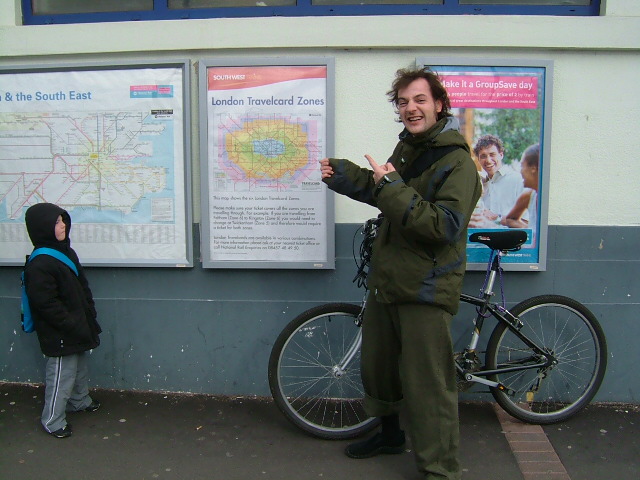
Presenting ... Graham Allcott and the Peters Projection! (Why is he looking at us like that?)
a little chit-chat, April 1819
"Last Sunday I took a Walk towards highgate and in the lane that winds by the side of Lord Mansfield's park I met Mr Green our Demonstrator in conversation with Coleridge - I joined them, after enquiring by a look whether it would be agreeable - I walked with him at his alderman-after-dinner pace for near two miles I suppose in those two Miles he broached a thousand things - let me see if I can give you a list - Nightingales, Poetry - on Poetical sensation - Metaphysics - Different genera and species of Dreams - Nightmare - a dream accompanied by a sense of touch - single and double touch - A dream related - First and second consciousness - the difference explained between will and Volition - so my metaphysicians from a want of smoking the second consciousness - Monsters - the Kraken - Mermaids - southey believes in them - southeys belief too much diluted - A Ghost story - Good morning - I heard his voice as he came towards me - I heard it as he moved away - I heard it in all the interval - if it may be called so. He was civil enough to ask me to call on him at Highgate Good Night! It looks so much like rain I shall not go to town to day; but put it off till tomorrow -"
Keats, writing to his brother George and sister-in-law Georgiana
Keats, writing to his brother George and sister-in-law Georgiana
Monday, April 03, 2006
numberland
In the second of what might be a whole series of pop posts with 'Rugby roots', unhemmed invites you to lend your ears to numberland.
Saturday, April 01, 2006
Dubes

I've not asked Dubes if he minds me 'promoting' this fantastic slice of pure pop magic, but until he complains that's what I intend to do. I only heard it for the first time a moment ago: if you listen hard you can hear Rugby in the background. (Or is that just me?)
Sunday, March 26, 2006
Bernice Rubens on Elias Canetti
"It was during this time [in the 1950s, shortly after her marriage to Rudi Nassauer] that a Mr Elias Canetti came into our lives, and seemed to lodge there permanently. I disliked him from the start. I thought him a scrounger, but Rudi was much taken with him. Mr Canetti had written one novel, Auto Da Fé, which Rudi had read and was deeply impressed by. According to its author, so was the whole of Europe. Over the years I got to know this man and I realised he had but one single talent. That of self-promotion. He created mystery about himself. If you wanted to phone him, for instance, you had to let it ring twice. Then you had to put the phone down and ring again. Certain people could approach him, but only if they'd had a reliable recommendation. I thought it all rather pathetic. My father met him once and declared him evil. And as it turned out, he was right, though evil might have been an overstatement. He did not have the imagination to be evil. He was wicked rather, depraved, vicious and spiteful. His own life was dull and uneventful, and to compensate he would create intrigue in the lives of other people.
"My marital situation fascinated Canetti, and he curried favour with K [Rudi's mistress] in order to stir the pot. He moved around Hampstead couples and loners doling out destructive advice and waiting, with infinite pleasure, for the shit to hit the fan. He himself was married to a rather gentle victim, Vesa. He told me once how he envied me my children and what a sorrow it was for him that Vesa couldn't have any. Later I was to hear from Vesa herself that it was he who did not want any children and insisted on taking steps to prevent it. I hated that man. He was the only person in my life that I have ever hated. And I loved that hatred. It inspired me. It was almost a creative force. One day, I was driving up Haverstock Hill and Mr Canetti, deep in filthy thought, crossed the road in front of me. It was not a pedestrian crossing, and I could, quite legally, have killed him on the spot. "He came out of nowhere, m'Lud. It was impossible to pull up." But I refrained. I needed him around so that I could go on hating him. About 30 years later, he left England and went to live in Zurich. Nobody regretted his departure. As he had so often predicted, and had no doubt promoted, he won the Nobel prize and eventually died of old age. I marvelled that a man of such perverse nature could die of natural causes."
Strong stuff.
"My marital situation fascinated Canetti, and he curried favour with K [Rudi's mistress] in order to stir the pot. He moved around Hampstead couples and loners doling out destructive advice and waiting, with infinite pleasure, for the shit to hit the fan. He himself was married to a rather gentle victim, Vesa. He told me once how he envied me my children and what a sorrow it was for him that Vesa couldn't have any. Later I was to hear from Vesa herself that it was he who did not want any children and insisted on taking steps to prevent it. I hated that man. He was the only person in my life that I have ever hated. And I loved that hatred. It inspired me. It was almost a creative force. One day, I was driving up Haverstock Hill and Mr Canetti, deep in filthy thought, crossed the road in front of me. It was not a pedestrian crossing, and I could, quite legally, have killed him on the spot. "He came out of nowhere, m'Lud. It was impossible to pull up." But I refrained. I needed him around so that I could go on hating him. About 30 years later, he left England and went to live in Zurich. Nobody regretted his departure. As he had so often predicted, and had no doubt promoted, he won the Nobel prize and eventually died of old age. I marvelled that a man of such perverse nature could die of natural causes."
Strong stuff.
Saturday, March 25, 2006
hungry sailors
"Accordingly our day's ration was brought out, and seating ourselves on a detached fragment of rock, we proceeded to discuss it. First we divided it into two equal portions, and, carefully rolling one of them up for our evening's repast, divided the remainder again as equally as possible, and then drew lots for the first choice. I could have placed the morsel that fell to my share upon the tip of my finger; but notwithstanding this I took care that it should be full ten minutes before I had swallowed the last crumb. What a true saying it is that 'appetite furnishes the best sauce.' There was a flavour and a relish to this small particle of food that under other circumstances it would have been impossible for the most delicate viands to have imparted."
Herman Melville, Typee (1846), Chapter VII
Herman Melville, Typee (1846), Chapter VII
Friday, March 24, 2006
Candid Wajda

Strictly speaking, I didn't ask his permission to slap this up on my 'semi-inaccessible' (thanks to Herr Douglas Ross for this most elegant adjective) webspace; nor indeed to take the photo in the first place. However, I felt in my bones that the great man not only wouldn't mind, but might even approve. (He's the chap with grey hair, looking towards the windows. He turned 80 the other day, you know.)
Monday, March 20, 2006
Thursday, March 16, 2006
Sławomir Mrożek 19.x.1963 Chiavari
Gazety czytuję. Z Echa Krakowa wciąż się dowiaduję, a to, że raz Józef Panek, z Technikum z Krzeszowic, znalazł pieczarkę o nóżce 14cm, średnicy kapelusza 21cm, to znów ktoś bardzo duże dwa pomidory wyhodował, z Przekroj zaś, że w Lipsku pokazano wynalazek polegający na tym, że marynarki się nie będzie już szyło, tylko kleiło. Na razie opracowano tylko technikę sklejenia górnej części marynarki, ale praca trwają. Było nawet zdjęcie tej marynarki, całkiem porządna marynarka, niczego sobie.
Friday, March 10, 2006
that's just, like, your opinion, man
'The Early Christian Father's "inter urinas et faeces nascimur" clings to sexual life and cannot be detached from it in spite of every effort at idealization.'
Pelican Freud vol. 8 Case Histories I 'Dora' and 'Little Hans', pp. 62-3
Pelican Freud vol. 8 Case Histories I 'Dora' and 'Little Hans', pp. 62-3
Thursday, March 09, 2006
Tuesday, March 07, 2006
a flamboyant bow
'His respect for Hierarchy, and particularly the Dignitaries of the Church, has been more than once exhibited in the course of his work. Mr Seward saw him presented to the Archbishop of York, and described his Bow to an ARCH-BISHOP, as such a studied elaboration of homage, such an extension of limb, such a flexion of body, as have seldom or ever been equalled.'
Boswell's Life of Johnson, April 1783
Boswell's Life of Johnson, April 1783
Monday, March 06, 2006
a first-class 'almost'
'Protection against stimuli is an almost more important function for the living organism than reception of stimuli.'
Freud, 'Beyond the Pleasure Principle'
Freud, 'Beyond the Pleasure Principle'
conjecture in the saddle
One of Baudelaire's definitions of beauty: "something slightly vague, giving rein to conjecture".
(The Essence of Laughter, 1956, p 166; scooped up by the beautifully vague Charles Simic)
(The Essence of Laughter, 1956, p 166; scooped up by the beautifully vague Charles Simic)
Wednesday, March 01, 2006
Donald Davidson on 'the underlying paradox of irrationality'
'If we explain it too well, we turn it into a concealed form of rationality; while if we assign incoherence too glibly, we merely compromise our ability to diagnose irrationality by withdrawing the background of rationality needed to justify any diagnosis at all.'
(from 'Paradoxes of Irrationality' in Philosophical Essays on Freud, eds. Wollheim & Hopkins 1982)
(from 'Paradoxes of Irrationality' in Philosophical Essays on Freud, eds. Wollheim & Hopkins 1982)
Kalmykia
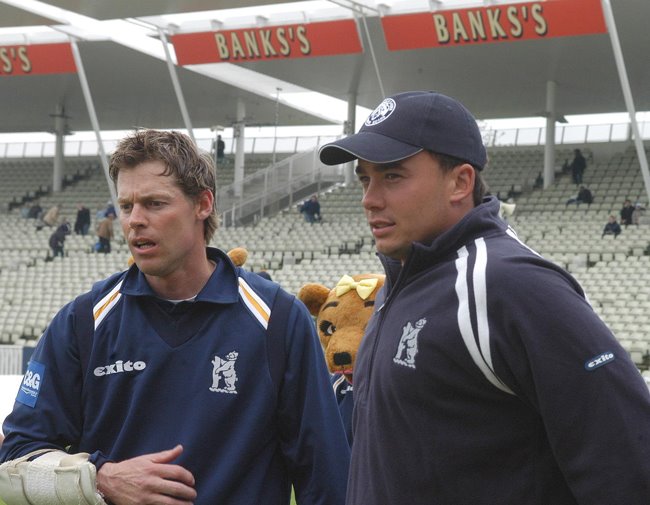
As even those merely given to casual pottering around these parts (and no shame in that) cannot help but have noticed, unhemmed has got to the ground its ear, on the pulse a finger, and generally oodles of nous when it comes to things cultural, things countercultural, and things shonkily tertium quiddish. It will come, then, as no surprise to hear that Radio 4's Book of the Week is to thank for sending us in the direction of all this stuff. I particularly like this snap of Warwickshire's finest.
Monday, February 27, 2006

Sunday, February 26, 2006
he began anywhere
"I have heard Coleridge talk, with eager musical energy, two stricken hours. his face radiant and moist, and communicate no meaning whatsoever to any individual of his hearers, - certain of whom, I for one, still kept eagerly listening in hope; the most had long before given up, and formed (if the room were large enough) secondary humming groups of their own. He began anywhere ..."
(Carlyle's The Life of John Sterling, 1851)
(Carlyle's The Life of John Sterling, 1851)
Friday, February 24, 2006
Wednesday, February 22, 2006
Pelmanism
In 1938, when he would have been 30 or 31 years old, Louis MacNeice published 'A Personal Essay' entitled 'Modern Poetry'. I wonder will it be reissued for the centenary of his birth next year?
"Neither Spender nor Auden ... is egocentric when compared with epicurean or dilettante poets like Housman and Pound. Epicureanism, being egocentric, lacks tension. Auden's admiration for the objective world is founded on that cosmic pride which, as distinct from personal pride, lies at the base of Christianity. (He holds that Christianity should be taken up into Communism.) Hence his belief, frivolously expressed, that 'Pelmanism' is an important factor both in art and in the good life. The Epicurean, like the Artist for Art's sake, will have no use for pelmanism. Why burden his mind with facts which cannot affect his own life? The Epicurean does not appreciate Otherness as such."
In an uncharacteristically generous moment, on 7 October 2003 to be precise, the lousy Daily Telegraph published these sublime sentences: "Iain Duncan Smith has ... a ‘hinterland’ of interests beyond politics. His hobbies include whistling, lawn-mowing and Pelmanism."
"Neither Spender nor Auden ... is egocentric when compared with epicurean or dilettante poets like Housman and Pound. Epicureanism, being egocentric, lacks tension. Auden's admiration for the objective world is founded on that cosmic pride which, as distinct from personal pride, lies at the base of Christianity. (He holds that Christianity should be taken up into Communism.) Hence his belief, frivolously expressed, that 'Pelmanism' is an important factor both in art and in the good life. The Epicurean, like the Artist for Art's sake, will have no use for pelmanism. Why burden his mind with facts which cannot affect his own life? The Epicurean does not appreciate Otherness as such."
In an uncharacteristically generous moment, on 7 October 2003 to be precise, the lousy Daily Telegraph published these sublime sentences: "Iain Duncan Smith has ... a ‘hinterland’ of interests beyond politics. His hobbies include whistling, lawn-mowing and Pelmanism."
Monday, February 20, 2006

Sunday, February 19, 2006
the poll
Crikey. It's been a rum couple of days for unhemmed. Let me explain (thus breaking, or at least bending, the unwritten rule that unhemmed doesn't deal in explanations). I'll try and keep it brief.
I was admiring this site a couple of days ago. The beard-poll there tickled my fancy, and I was intrigued by the promise that a simple click or two might see it reproduced on unhemmed. While setting this up, possibly coincidentally, Blogger went a bit bananas and started sending me error messages. Lo, the poll appeared, but my slapdash presentation gave the impression that research was being done into the future of my own face. For a day or two - it seemed like a lifetime - unhemmed refused to accept any alterations or new material and continued to return the pesky error messages. Meanwhile, a host of surfers (perhaps as many as one or two) cast their votes with the wrong chin in my mind. Chaos.
Happily, Blogger has got its act together this morning and I've been able to pull the misleading beard-poll. My sincere apologies to Saeed for having skewed the results of his research. There is, after all, rather a lot at stake.
I was admiring this site a couple of days ago. The beard-poll there tickled my fancy, and I was intrigued by the promise that a simple click or two might see it reproduced on unhemmed. While setting this up, possibly coincidentally, Blogger went a bit bananas and started sending me error messages. Lo, the poll appeared, but my slapdash presentation gave the impression that research was being done into the future of my own face. For a day or two - it seemed like a lifetime - unhemmed refused to accept any alterations or new material and continued to return the pesky error messages. Meanwhile, a host of surfers (perhaps as many as one or two) cast their votes with the wrong chin in my mind. Chaos.
Happily, Blogger has got its act together this morning and I've been able to pull the misleading beard-poll. My sincere apologies to Saeed for having skewed the results of his research. There is, after all, rather a lot at stake.
Friday, February 17, 2006
Wednesday, February 15, 2006
dictionary dell
'1827 COLERIDGE Table-t. 8 July, In the Trinity there is, 1. Ipseity. 2. Alterity. 3. Community.'
Tuesday, February 14, 2006
Sunday, February 12, 2006

Monday, February 06, 2006

Wednesday, February 01, 2006
Behold the moral Pecksniff!
"It has been remarked that Mr. Pecksniff was a moral man. So he was. Perhaps there never was a more moral man than Mr. Pecksniff: especially in his conversation and correspondence. It was once said of him by a homely admirer, that he had a Fortunatus's purse of good sentiments in his inside. In this particular he was like the girl in the fairy tale, except that if they were not actual diamonds which fell from his lips, they were the very brightest paste, and shone prodigiously. He was a most exemplary man: fuller of virtuous precept than a copy-book. Some people likened him to a direction-post, which is always telling the way to a place, and never goes there: but these were his enemies, the shadows cast by his brightness; that was all. His very throat was moral. You saw a good deal of it. You looked over a very low fence of white cravat (whereof no man had ever beheld the tie for he fastened it behind), and there it lay, a valley between two jutting heights of collar, serene and whiskerless before you. It seemed to say, on the part of Mr. Pecksniff, 'There is no deception, ladies and gentlemen, all is peace, a holy calm pervades me.' So did his hair, just grizzled with an iron-grey which was all brushed off his forehead, and stood bolt upright, or slightly drooped in kindred action with his heavy eyelids. So did his person which was sleek though free from corpulency. So did his manner, which was soft and oily in a word, even his plain black suit, and state of widower and dangling double eye-glass, all tended to the same purpose, and cried aloud, 'Behold the moral Pecksniff!'"
(from Martin Chuzzlewit)
(from Martin Chuzzlewit)
Tuesday, January 31, 2006
millennial
December 1999. Robert Taylor, Interweb impresario, predicts in the New York Times that we'll one day be wearing 'an unobtrusive device that will record in full color and sound everything that you see or point your head at, or, depending on how many of them you have, everything that's around you. And share it. Every waking and sleeping moment in your life will be recorded. And you will be able to store and retrieve it and do what you will with it'.
Geoffrey Hartman, in the course of a lecture of 2000 called 'Life and Learning', responds:
'It would seem to me that we already have world enough, though not time enough, and that passage from 'you will be able to store and retrieve it' to 'and do what you will with it' is far more questionable than that easy, consequential 'and' suggets. Taylor elides the moral problem of the use to which knowledge will be put, especially in an age of information technology. For what is lacking and difficult to increase is studium, the capacity to think and interpret, which discovers the curvature of space or of expression, and accepts that, if 'all's oblique,' we can never coincide entirely with ourselves, or a presumed identity.'
Geoffrey Hartman, in the course of a lecture of 2000 called 'Life and Learning', responds:
'It would seem to me that we already have world enough, though not time enough, and that passage from 'you will be able to store and retrieve it' to 'and do what you will with it' is far more questionable than that easy, consequential 'and' suggets. Taylor elides the moral problem of the use to which knowledge will be put, especially in an age of information technology. For what is lacking and difficult to increase is studium, the capacity to think and interpret, which discovers the curvature of space or of expression, and accepts that, if 'all's oblique,' we can never coincide entirely with ourselves, or a presumed identity.'
Sunday, January 29, 2006
pod of whales
unhemmed is down with whalemania. Go whales.
Pilot whale doing the do. Or, more technically, an overture.
Here's another.
(they were tucked away here)
Pilot whale doing the do. Or, more technically, an overture.
Here's another.
(they were tucked away here)
Thursday, January 26, 2006
The 1930s
 Maybe there is an argument for a separate Empson blog. 'The stock device of the play [The Beggar's Opera] is a double irony like a Seidlitz powder, piling a dramatic irony onto what was already an irony. This forces one to read back a more complex irony onto the first one, and the composure of language of the characters makes us feel that the speaker took the whole sense for granted. So he is a pastoral character; he moves among fundamental truths.'
Seidlitz powder, the Pharmaceutical Journal tells us, was thought to help treat, among other things, the 'oedematous tumours of the legs in literary men'.
Wednesday, January 25, 2006

Tuesday, January 24, 2006
february's quiz
These are the first lines of 'The Fire Sermon' from that poem 'The
Waste Land' by T S Eliot.
"The river's tent is broken: the last fingers of leaf
Clutch and sink into the wet bank."
Can anybody explain what the word 'tent' is up to?
Empson soup
I might get a mid-day phone-call: 'Jones, I have a young poet coming
to lunch. I'd be very glad of your support.' I would find him in the
kitchen in the fawn dressing-gown which he habitually wore over his
clothes as a comfortable house-coat, busily making last-minute
preparation and turning a mess in a saucepan. This was 'Empson soup',
a dish which almost defies description. It was concocted from a Heinz
tin, to which was added sundry left-overs of vegetables he had tucked
away in corners of the fridge, plus the left-overs of yesterday's
soup, so that one day's soup would not be noticeably different from
the next. There was a large quantity of solids – butterbeans, chunks
of celery, slabs of cabbage and bits of boiled egg, and much reduced
and recycled gunge, but one would not have been surprised to find
anything in it, even false teeth. You could not stir it, you could
only turn it over. He ate it every day and Hetta maintained it was the
cause of his ulcer.
John Henry Jones, 'Diary', LRB 17 August 1989
Monday, January 23, 2006
uncanny
The Brood-bird
My encircler, I am placing a lock
upon my lips, though nine deaths
were in my unhemmed mouth
or thy mouth breast-white to my breast.
The tongue and knot and pulsing oil
of death without death goes round
in a thread, so I see neither the black
nor the white, tonight, in the upper chamber:
only the knee-woman, the world-woman,
the woman of songs.
Medbh McGuckian
My encircler, I am placing a lock
upon my lips, though nine deaths
were in my unhemmed mouth
or thy mouth breast-white to my breast.
The tongue and knot and pulsing oil
of death without death goes round
in a thread, so I see neither the black
nor the white, tonight, in the upper chamber:
only the knee-woman, the world-woman,
the woman of songs.
Medbh McGuckian
Sunday, January 15, 2006
why is the panel on the right there a bit jiggered of late?
"Here's the genius of the bunch for my money," Van Horne said, wiping the corners of his mouth dry with a two-finger pinching motion. "Kienholz. A Marisol with guts. You know, the tactility; there's nothing monotonous or pre-ordained about it. That's the kind of thing you should be setting your sights toward. The richness. The Vielfaltigkeit, the, you know, the ambiguity. No offense, friend Lexa, but you're a Johnny-one-note with those little poppets of yours."
The Witches of Eastwick (1984)
The Witches of Eastwick (1984)
Thursday, January 12, 2006
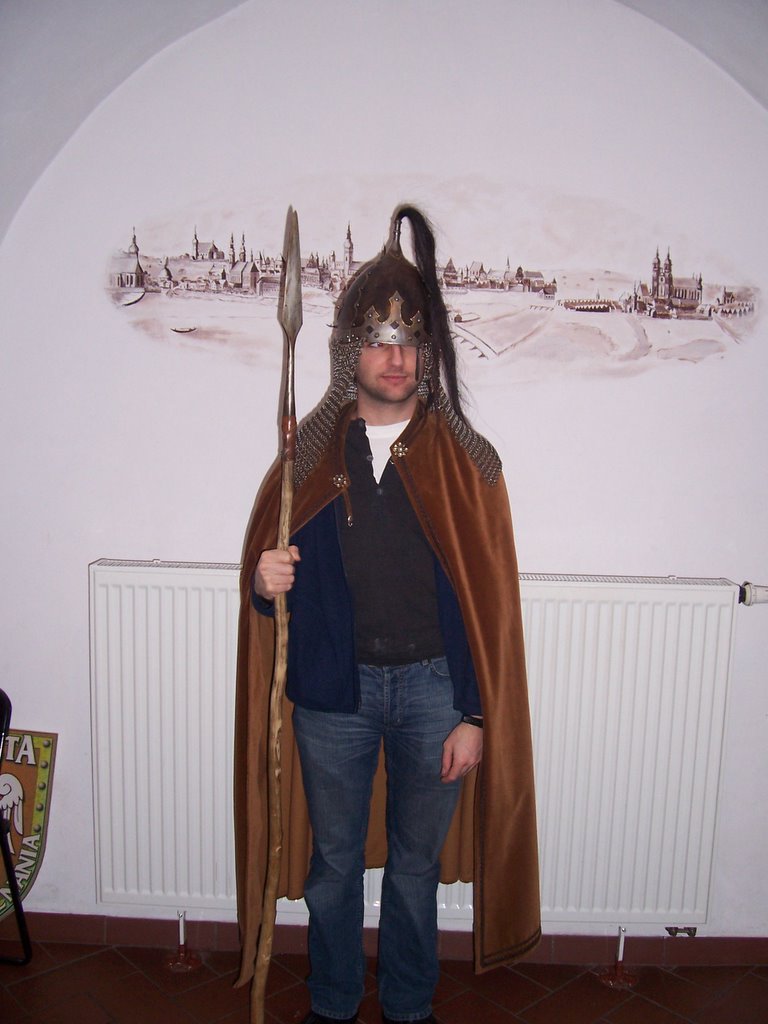
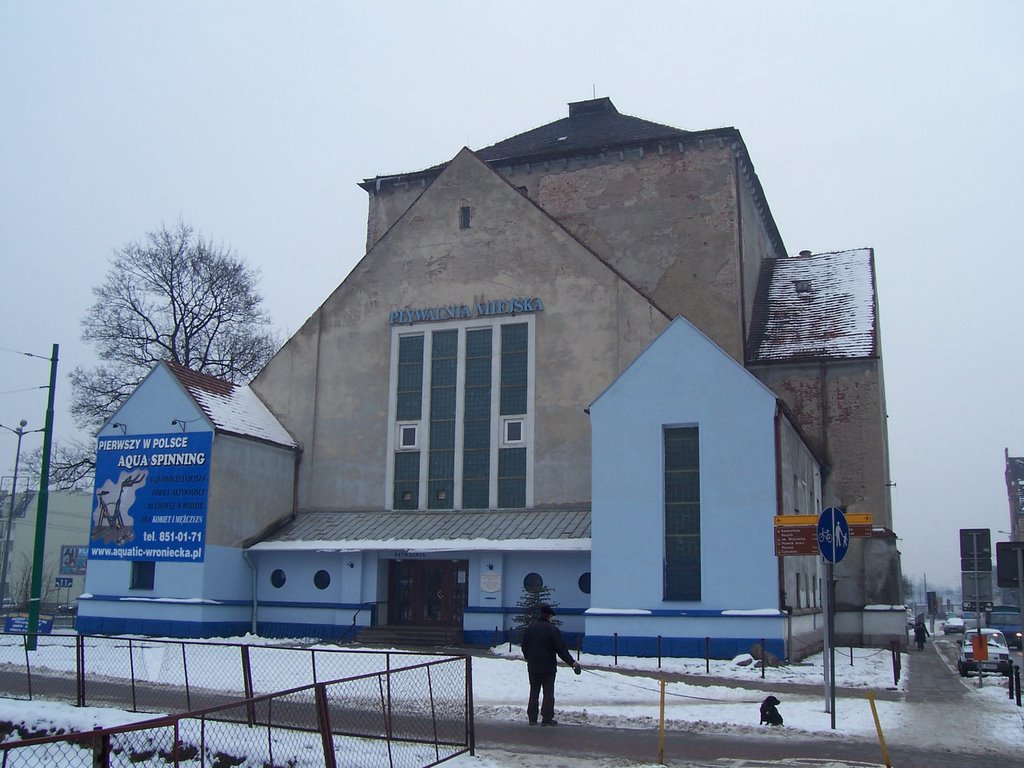
Alan's first post (thanks to Madzia for showing me her city!):
In my mind, the prime attraction of Poznan is it's fantastic multimedia history show, 'Makieta Dawnego Poznania', including flashy lights and fires-made-out-of-coloured-handkerchiefs-and-a-wind-machine (http://www.makieta.poznan.pl/). The commentary is available in several European languages, though, as the ladies selling the tickets told us, the German version is hardly ever requested. We weren't very surpised about this after we'd seen the show, as the commentary was so anti-German that its German version might as well have been called 'wszystko przez Was'.
You also get to dress up at the Makieta!
Another interesting place in Poznan: the former synagogue, aka the swimming pool.
ought one to encourage cheese?

A question rarely far from what's left of my mind. By popular demand - half a wheel - Boxing Day 2005.
Closely Observed Trains
What a nice surprise! If you buy Saturday's Independent, you get Jiri Menzel's adaptation free with it, as something called a DVD. Extraordinary.
Friday, January 06, 2006

Tuesday, January 03, 2006
someone else's diary
Whose? Why, Alan Bennett's. It's 22 May 2005.
'Reading Frank Kermode's review of John Haffenden's life of Empson makes me regret a little that Empson was cut out of The History Boys. In the first version of the play Hector sings the praises of Sheffield where he had been taught by Empson, then recounts to the boys wanting to go to Cambridge the circumstances of Empson's downfall at Magdalene. 'So when you say Cambridge University to me, I say to you "A prophylactic in the wardrobe"' - this last delivered like a war-cry. Empson was not the only casualty in the play. Simone Weil got the boot, as did Nina Simone and Simone Signoret, Jowett (of Balliol fame), James Agate, Jane Austen, Molly Bloom, Hegel and Henry James, all of them biting the distinguished dust.'
(from the LRB)
'Reading Frank Kermode's review of John Haffenden's life of Empson makes me regret a little that Empson was cut out of The History Boys. In the first version of the play Hector sings the praises of Sheffield where he had been taught by Empson, then recounts to the boys wanting to go to Cambridge the circumstances of Empson's downfall at Magdalene. 'So when you say Cambridge University to me, I say to you "A prophylactic in the wardrobe"' - this last delivered like a war-cry. Empson was not the only casualty in the play. Simone Weil got the boot, as did Nina Simone and Simone Signoret, Jowett (of Balliol fame), James Agate, Jane Austen, Molly Bloom, Hegel and Henry James, all of them biting the distinguished dust.'
(from the LRB)
Sunday, December 18, 2005
a bountiful answer that fits all questions
"It is like a barber's chair that fits all buttocks: the pin-buttock, the quatch-buttock, the brawn-buttock, or any buttock."
(All's Well That Ends Well)
(All's Well That Ends Well)
Tuesday, December 13, 2005
where my heart lies
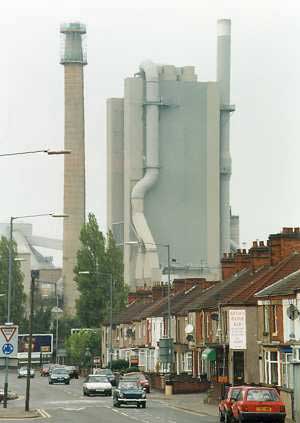
Thanks to caskared for these links. (Caskared:I hope you don't mind being referred to by that particular handle - if so, let me know and I can change it in the blink of an eye.) I was recently knocked sideways by the strength of feeling induced in me by the sight of the cement works swathed in fog as my train drew in to Rugby station. They probably shouldn't be burning tyres there. But they certainly shouldn't be on a list of the ten worst buildings in the UK. Odd list, this - almost every one a wonder, seems to me.
Bacon's prose
According to Shelley, Bacon's prose 'is a strain which distends, and then bursts the circumference of the hearer’s mind, and pours itself forth together with it into the universal element with which it has perpetual sympathy'. So be mighty careful with it.
I like the sound of this Vespasian fellow. Wonder what else he got up to?
I like the sound of this Vespasian fellow. Wonder what else he got up to?
Friday, December 02, 2005



Monday, November 28, 2005
Friday, November 25, 2005
The South-Sea House
'The simultaneous sound of his [Evans the clerk's] well-known rap at the door with the stroke of the clock announcing six, was a topic of never-failing mirth in families which this dear old bachelor gladdened with his presence. Then was his forte, his glorified hour! How would he chirp, and expand, over a muffin! How would he dilate into secret history!'
Charles Lamb
Charles Lamb
I can't stand another minute
In the 'Foreword' to 'Silence: Lectures and Writings by John Cage' the author recalls delivering his 'Lecture on Nothing' in 'about 1949 ... at the Artists' Club on Eighth Street in New York City ... Jeanne Rynal, I remember, stood up part way through, screamed, and then said, while I continued speaking, "John, I dearly love you, but I can't bear another minute." She then walked out. Later, during the question period, I gave one of six previously prepared answers regardless of the question asked. This was a reflection of my engagement in Zen.'
He also shares this memory: 'As I look back, I realize that a concern with poetry was always with me. At Pomona College, in response to questions about the Lake poets, I wrote in the manner of Gertrude Stein, irrelevantly and repetitiously. I got an A. The second time I did it I was failed.'
He also shares this memory: 'As I look back, I realize that a concern with poetry was always with me. At Pomona College, in response to questions about the Lake poets, I wrote in the manner of Gertrude Stein, irrelevantly and repetitiously. I got an A. The second time I did it I was failed.'
Thursday, November 24, 2005
The King of Aberdeen

UNHEMMED has reason to believe that this man accessed the site from Aberdeen today at 6-02am, or thenabouts. Good on him!
George Szirtes digging Jeff Bridges
"Paterson points to the twin dangers, as he sees them, of Populism on the one side and Postmodernism on the other. I'll leave Postmodernism out of it because it seems to me he uses the term loosely to mean people who are in fact Modernists in the post-Poundian sense. I am more interested here in his idea of Populism. He never quite defines the term, talking merely about "chicken-soup anthologies full of lousy poems". I have an idea what anthologies he might have been talking about, but it would have been good had he pointed to a few examples of lousy poems as illustration, for lousiness is a self-validating term. "Yeh, well that's just your opinion, man," as the Dude says in The Big Lebowski. I don't see why anyone should have a problem with chicken-soup. Nor would anyone who was genuinely hungry. What are they supposed to do? Starve until they can eat what the committee has chosen to call cake?"
This year's T S Eliot lecture taking issue with last year's T S Eliot lecture.
My brain has got so bent out of shape that I can't stop myself suggesting that the phrase 'genuinely hungry' is also the phrase 'genuinely Hungary' in disguise.
Looks to me like Jeff Bridges's gaff rocks pretty hard.
This year's T S Eliot lecture taking issue with last year's T S Eliot lecture.
My brain has got so bent out of shape that I can't stop myself suggesting that the phrase 'genuinely hungry' is also the phrase 'genuinely Hungary' in disguise.
Looks to me like Jeff Bridges's gaff rocks pretty hard.
Haemony
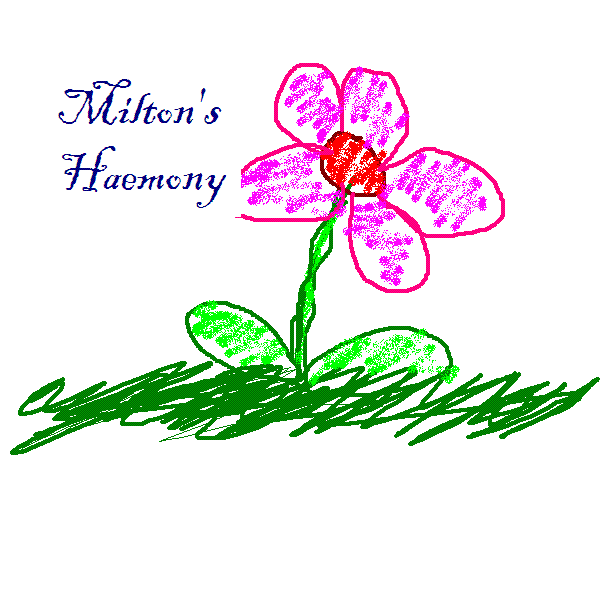
Name given by Milton to an imaginary plant having supernatural virtues.
1634 MILTON Comus 638 He called it Hæmony, and gave it me..as of sovran use 'Gainst all enchantments, mildew blast, or damp, Or ghastly Furies' apparition.
Tuesday, November 22, 2005

Monday, November 21, 2005
It was that John Donne who said
On a huge hill,
Cragged and steep, Truth stands, and hee that will
Reach her, about must, and about must goe;
Cragged and steep, Truth stands, and hee that will
Reach her, about must, and about must goe;
Wednesday, November 16, 2005
Did Elias Canetti approve of the 'in-joke'?
So, it turns out that
22 Across : Law, cheating it (anag) (5,8)
is just an anagram, and the solution - Wigan Athletic - has no obvious connection with illegal activity. That made it pretty plain that
15 Down : Knocking sound (3-3)
would be 'tat-tat' as in 'rat-a-tat-tat'. I was stumped by
12 Down : Celebration (8)
for an eternity or two, but I realised they wanted, as a solution to a different clue, not 'leitmotif', but rather 'leitmotiv', the v at the end of which meshed beautifully with the sixth letter of 'festival'.
Problem solved.
22 Across : Law, cheating it (anag) (5,8)
is just an anagram, and the solution - Wigan Athletic - has no obvious connection with illegal activity. That made it pretty plain that
15 Down : Knocking sound (3-3)
would be 'tat-tat' as in 'rat-a-tat-tat'. I was stumped by
12 Down : Celebration (8)
for an eternity or two, but I realised they wanted, as a solution to a different clue, not 'leitmotif', but rather 'leitmotiv', the v at the end of which meshed beautifully with the sixth letter of 'festival'.
Problem solved.
Monday, November 14, 2005
Moravia-mania
The Kingdom of Moravia, now in the SE of the Czech Republic. Its major city is Brno, which is currently my favourite placename of all time. Sigmund Freud was born in Moravia, in Freiberg, today known as Pribor. The malt used to brew Budvar is supposed to be Moravian.
George Moore
"On 27 May his ashes were buried on Castle Island in Lough Carra, co. Mayo, where he had played as a boy. Over his crypt was erected a wooden marker inscribed ‘He deserted his family and friends for his art’; however, ‘deserted’ was softened to ‘forsook’ when carved on a permanent stone monument."
DNB
DNB
Saturday, November 12, 2005
the latest stop-press information on literature 003
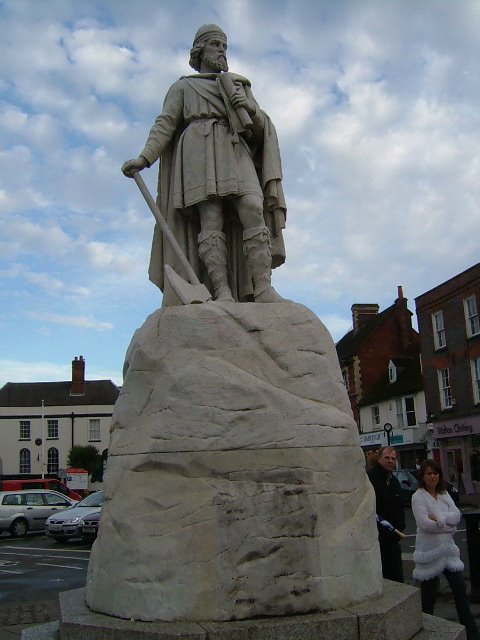
"Tennyson has always weighed on me as the original National Heritage Poet - all that is bogus, empty, self-parodic, dishonest, false and dead-as-doornails in the culture is epitomized by his verse. Alfred Lawn Tennyson, as Joyce called him. His cadences remind me of cheap firetongs, flat clangy tin trays furred with velvet, the boring sonorities of Gielgud's voice. But I can't let go of 'In Memorian VII', one of the saddest love lyrics in the language ...
"The simple-minded patriotism, the deep racism, the professional Angst and gravid sonorous chill of the verse all remind me of a solemn Victorian statue of King Alfred which I once saw in a dreary market town somewhere in the south of England."
(Tom Paulin, TLS, 2 October 1992)
Wantage, coming back to haunt me.
Sunday, November 06, 2005

Sunday, October 30, 2005




Wednesday, October 26, 2005
Blake

"The tree which moves some to tears of joy is, in the eyes of others, only a green thing which stands in the way."
Wednesday, October 19, 2005
Charles Lamb
from his essay 'All Fools' Day':
'I had more yearnings towards that simple architect, that built his house upon the sand, than I entertained for his more cautious neighbour ... I venerate an honest obliquity of understanding. The more laughable blunders a man shall commit in your company, the more tests he giveth you, that he will not betray or overreach you.'
'I had more yearnings towards that simple architect, that built his house upon the sand, than I entertained for his more cautious neighbour ... I venerate an honest obliquity of understanding. The more laughable blunders a man shall commit in your company, the more tests he giveth you, that he will not betray or overreach you.'
Friday, October 07, 2005
The Secretary of the Stanley Cavell Fan Club Writes ...
b. Home Counties, the counties nearest to London, namely Surrey, Kent, Essex (and formerly Middlesex); sometimes with the addition of Hertfordshire, Buckinghamshire, Berkshire, and occasionally Sussex.
1898 Mddx. & Herts. N. & Q. IV. 153 The publication,..will..relate not only to London, Middlesex and Hertfordshire, but also to Essex, Buckinghamshire, Berkshire, Surrey and Kent; that is, to the Home Counties. 1959 I. & P. OPIE Lore & Lang. Schoolch. xii. 233 In London and the Home Counties the police now chase off the streets even the simple waits singing Christmas carols. 1966 Listener 11 Aug. 218/1 The chances are..small that a writer setting his play in outer suburbia or inner Home County will make of it more than a painful banality. 1972 J. BLACKBURN For Fear of Little Men ii. 29 Her accent clashed dramatically with the jargon of Home Counties suburbia.
1898 Mddx. & Herts. N. & Q. IV. 153 The publication,..will..relate not only to London, Middlesex and Hertfordshire, but also to Essex, Buckinghamshire, Berkshire, Surrey and Kent; that is, to the Home Counties. 1959 I. & P. OPIE Lore & Lang. Schoolch. xii. 233 In London and the Home Counties the police now chase off the streets even the simple waits singing Christmas carols. 1966 Listener 11 Aug. 218/1 The chances are..small that a writer setting his play in outer suburbia or inner Home County will make of it more than a painful banality. 1972 J. BLACKBURN For Fear of Little Men ii. 29 Her accent clashed dramatically with the jargon of Home Counties suburbia.
Monday, October 03, 2005
Friday, September 30, 2005

the latest stop-press information on literature 002
'Ezra Pound was originally in the highly subjective phase 12, but Yeats moved him among the humanitarians of the late objective phases after seeing him feed all the cats at Rapallo.'
(Richard Ellmann, Yeats: The Man and the Masks)
(Richard Ellmann, Yeats: The Man and the Masks)
Sunday, September 25, 2005

Wednesday, September 21, 2005
scrapbook(s)
Don't like his poems so much, or the bits of waffle and witter that he turns out for the TLS (though possibly - certainly - I'm inordinately jealous), but I've just been through the selection of his work in a Penguin Modern Poets that I borrowed from the British Council library for the Michael Donaghy, and I got curious enough to Google Hugo, and turned this up pronto -
I find such a predilection more than mildly interesting, and sympathise with it. It put me in mind of Julian Barnes's description of Flaubert's Bouvard et Pecuchet (although what Williams gets up to is clearly very different):
(this is from The Paris Review 157, Fall 2000)
Hugo Williams often spends the evening pasting memorabilia into his scrapbook. Everything goes in: newspaper clippings about him, party invitations, train tickets, photographs of Williams and his family, as well as people whose names he can't remember. Sometimes, at literary events, he just walks about snapping randomly. There are even letters in his own handwriting, which he never got round to posting. The scrapbook is running close to 60 volumes by now. The later chapters are in bright colour, but the really precious stuff is in black and white. Here is Hugo in short trousers, just after the war, with his father the actor Hugh Williams, and his mother Margaret Vyner, a model for Paris couturier Jean Patou, and later an actress herself. Here is Hugo, aged 14, on his way back to Eton after the holidays. In the colour scrapbook, he receives a major poetry prize for his latest collection, Billy's Rain; beside the photograph is a disgruntled commentary on the award by the Guardian's poetry critic. The juxtaposition amuses Williams. It simply all has to be recorded. As one of his poems has it, "The past is out of bounds. / But where else is there to go?"
I find such a predilection more than mildly interesting, and sympathise with it. It put me in mind of Julian Barnes's description of Flaubert's Bouvard et Pecuchet (although what Williams gets up to is clearly very different):
a novel about two earnest, illusion-filled clerks who try to understand the whole of human striving and the whole of human knowledge, who are defeated and then go back to being copyists - [it] is extraordinarily modern. And the second part of the book, the thought of simply giving the reader an accumulated heap of rubbish that the two heroes decide to copy down, is a phenomenally advanced idea for 1880; it is amazingly bold.
(this is from The Paris Review 157, Fall 2000)
Monday, September 19, 2005
Ralph in Maine, 1841, out loud
"How tardily men arrive at any result! how tardily they pass from it to another! The crystal sphere of thought is as concentrical as the geological structure of the globe. As our soils and rocks lie in strata, concentric strata, so do all men's thinkings run laterally, never vertically. Here comes by a great inquisitor with auger and plumb-line, and will bore an Artesian well through our conventions and theories, and pierce to the core of things. But as soon as he probes the crust, behold gimlet, plumb-line, and philosopher take a lateral direction, in spite of all resistance, as if some strong wind took everything off its feet, and if you come month after month to see what progress our reformer has made, not an inch has he pierced, you still find him with new words in the old place, floating about in new parts of the same old vein or crust. The new book says, 'I will give you the key to nature,' and we expect to go like a thunderbolt to the centre. But the thunder is a surface phenomenon, makes a skin-deep cut, and so does the sage. The wedge turns out to be a rocket. Thus a man lasts but a very little while, for his monomania becomes insupportably tedious in a few months. It is so with every book and person: and yet - and yet - we do not take up a new book, or meet a new man, without a pulse-beat of expectation. And this invincible hope of a more adequate interpreter is the sure prediction of his advent."
I particularly like The wedge turns out to be a rocket. The whole jing-bang here.
I particularly like The wedge turns out to be a rocket. The whole jing-bang here.
Sunday, September 18, 2005
Friday, September 16, 2005
the latest stop-press information on literature (001)
George Eliot held George Meredith's The Shaving of Shagpat to be a 'work of genius'.
Wednesday, September 14, 2005
Nothing like an interest in statistics as an index of rude health
.

Now, don’t just write, ‘I did this, and then I did that. And then I ... and then I ...’ See if you can make it more interesting than that, won’t you?
19.08.05
(a) Depart from Warszawa: 0843. Arrive in Ostroleka: 1106. 123km. 2hrs 23mins. Average speed: 52km/h.
(b) Depart from Ostroleka: 1150. Arrive in Augustow: 1353. 143km. 2hrs 3mins. 67km/h.
(c) Depart from Augustow: 1500. Arrive in Wilno: 1820 (Polish time). 247km. 3hrs 20mins. 74km/h.
Total distance: 513km. Car hours: 7hrs 46mins.
22.08.05
(d) Depart from Wilno: 0832 (Polish time). Arrive in Suwalki: 1150. 227km. 3hrs 18mins. 69km/h.
(e) Depart from Suwalki: 1328. Arrive in Bialystok: 1520. 124km. 1hr 52mins. 66km/h.
(f) Depart from Bialystok: 1631. Arrive in Warsaw: 1915. 204km. 2hrs 44mins. 74km/h.
Total distance: 555km. Car hours: 7hrs 54mins.
There and back: 1068km. Car hours: 15hrs 40mins.
(this may have the appearance of precision, but there is some guesswork going on)
(it may also have the appearance of some kind of advanced neurotic symptom, but rest assured - if I may take a moment to reassure you, whilst we're in parentheses - it's actually an accumulation of hard evidence to back up my suspicion that Schnucki is better at overtaking lorries than I am - you'll probably have already noticed that one of the many things conspicuously absent from the data above is the name of the driver - as August recedes into the very recent past and it becomes harder to remember who actually was driving, guessing is the only thing any of us will be able to do - so the 'evidence' ain't going to be up to much, hein? well? always making the mistake of trying to explain yourself ... always making the mistake of trying to explain yourself)

Now, don’t just write, ‘I did this, and then I did that. And then I ... and then I ...’ See if you can make it more interesting than that, won’t you?
19.08.05
(a) Depart from Warszawa: 0843. Arrive in Ostroleka: 1106. 123km. 2hrs 23mins. Average speed: 52km/h.
(b) Depart from Ostroleka: 1150. Arrive in Augustow: 1353. 143km. 2hrs 3mins. 67km/h.
(c) Depart from Augustow: 1500. Arrive in Wilno: 1820 (Polish time). 247km. 3hrs 20mins. 74km/h.
Total distance: 513km. Car hours: 7hrs 46mins.
22.08.05
(d) Depart from Wilno: 0832 (Polish time). Arrive in Suwalki: 1150. 227km. 3hrs 18mins. 69km/h.
(e) Depart from Suwalki: 1328. Arrive in Bialystok: 1520. 124km. 1hr 52mins. 66km/h.
(f) Depart from Bialystok: 1631. Arrive in Warsaw: 1915. 204km. 2hrs 44mins. 74km/h.
Total distance: 555km. Car hours: 7hrs 54mins.
There and back: 1068km. Car hours: 15hrs 40mins.
(this may have the appearance of precision, but there is some guesswork going on)
(it may also have the appearance of some kind of advanced neurotic symptom, but rest assured - if I may take a moment to reassure you, whilst we're in parentheses - it's actually an accumulation of hard evidence to back up my suspicion that Schnucki is better at overtaking lorries than I am - you'll probably have already noticed that one of the many things conspicuously absent from the data above is the name of the driver - as August recedes into the very recent past and it becomes harder to remember who actually was driving, guessing is the only thing any of us will be able to do - so the 'evidence' ain't going to be up to much, hein? well? always making the mistake of trying to explain yourself ... always making the mistake of trying to explain yourself)
Monday, September 12, 2005
Coming Attractions:
* Fantasy Arboretum *
(Sorry, I guess it should say 'Coming Attraction'. Although there's always that essay about Lithuania to look forward to.)
(Sorry, I guess it should say 'Coming Attraction'. Although there's always that essay about Lithuania to look forward to.)
Subscribe to:
Posts (Atom)